Bootz protocol v2 (sZTP++ or gZTP)
Objective
Define a structured data format for exchanging as much data with the network device as possible, to take the device from a factory state to a fully production supportable state.
Additionally, define both a dialout and dialin RPC service which can perform the boot workflow.
The overall design of bootz is meant to allow operators of equipment to provide a data-only bootstrap request and allow vendors the freedom to implement the intent based on their own internal APIs.
Bootstrap/Configuration Management End State
When thinking about what data is needed to transition a "factory-reset" device from that state into a production-managed state, we can divide the configuration into multiple units, which differ in how they are managed and interacted with. This is counter to the current model of vendor network devices which have a monolithic single configuration that stores all parameters[^1].
For the use cases in our or service provider networks, we consider the following units:
- Boot Config - Static “bootstrap” configuration required to get a device into a manageable state within the network. This configuration includes parameters such as the gRPC services that are to run, and the management connectivity configuration.
- Security Config - Policies related to provide device access - such as authentication and authorization configurations. This configuration explicitly controls access to who can write the configuration, read parameters from the device via telemetry, and interact with operational RPCs. This configuration can be considered to be separate from the base device configuration, since it is owned by a separate entity within the service provider management plane. It also should not be something that can be modified by an entity that is given read access to the configuration.
- Dynamic config - configuration of the device which is generated according to the topology, and services that are running on the device.
It is desirable for each of these elements of configuration to each have a single owner, who is able to declaratively replace the running configuration on the device without needing to consider contents of the other elements of the system (i.e., the dynamic configuration manager may be unaware of the bootstrap configuration, or the authentication configuration).
Design Options
To support such a concept, there are multiple potential solutions that we can consider:
Path based authorization for configuration
- This concept still has a single root configuration on the device. Clients
“own” part of the namespace of this configuration (e.g.,
/system/aaain OpenConfig), controlled bygnsi.Pathzconfiguration. - The positive of this approach is that it aligns with existing device
operational models, with a single configuration (other than
Pathzexists on the device). - The major downside of this approach is fragility - the “dynamic”
configuration described above is the catch-all configuration for the device,
and would ideally replace
/, however, it can no longer do this, since there exists data under the bootstrap configuration (for example,/interfacesentries that store the management interfaces) and the security configuration that must not be replaced. The “dynamic” configuration then must cherry-pick trees that are to be replaced, potentially at relatively deep levels in the hierarchy. Bugs or issues with which trees are replaced can render the device unmanageable, or can reflect a security problem (whereby a client that is not authorized to change security policies is able to do so). - Equally, authentication policies become more complex in this scenario - we
imply the existence of a new namespace (
Pathz), and create this new concept of multiple configurations solely to enforce the restrictions on the single configuration that we were trying to maintain.
Path based implementation details
gnsi.Pathzpolicy would limit specific OpenConfig paths from general writability- The response to the gNMI
SetRequestthat contains the OpenConfig configuration change (update, set, delete) is expected to indicate that the request failed if those paths are not writable by the caller - The full config replace would be responsible for only "replacing" specific
paths rather than a root level replace
/system/<subpaths>but excluding/system/aaa, or/interfaces/interface [name=\*]but exclude/interfaces[name=mgmt0|1], this introduces fragility and complexity in how the/interfaces/interfacelist or/systempaths are managed since they now have multiple writers.
Multiple namespaces for the configuration
- This is the approach that has been pursued with gNSI - whereby certain
subsets of the configuration are moved into a separate namespace (origin in
OpenConfig naming), which is not manipulated via gNMI’s
SetRPC. To support the bootstrap configuration, an additional ‘boot’ configuration namespace would be introduced. - A disadvantage of this approach is the change that it makes to existing device configurations, introducing the concept of multiple potentially overlapping configurations.
- An advantage of the approach is that there is clean separation according to the operational use case described above - a gNSI namespace exists for policies on the device; the ‘boot’ namespace would exist for configuration that is immutable after device boot; and the existing configuration becomes the dynamic configuration of the device. Each namespace can have its own policies for permissions, and client service. Client services need not know about each other’s configuration since replacing a configuration replaces only the namespace of that client.
Multiple namespace implementation details
- Data supplied by gNSI is considered as a separate namespace/configuration store that is treated independently of configuration interacted with via gNMI. All system AAA paths, certificates, keys, accounts and other gNSI covered data is contained in this namespace.
- If gNSI is enabled on the device all of the content covered via gNSI is
interacted with solely within this namespace. To interact with this content,
gNSI is used. gNSI
SetRequestsare ACL'ed viagnsi.Pathz. Additionally, gNSI endpoints would continue to provide set operations as well for those configuration elements. - OpenConfig and vendor configuration would not be allowed to configure those leaves.
Explicit exclusion of configuration based on a specification in gNMI.Set
- In this approach, rather than having separate namespaces be defined, a
client that was performing a
gNMI.Setrequest would include some additional information (likely defined through having a new extension message) that specified a set of paths that explicitly should not be modified through the contents of theSetRequest. Specifically, this would ensure that:- Should the payload of the
SetRequestspecify a path that was in the “paths that are not to be modified" list, an error would be returned. Replaceoperations that give the declarative set of end contents for a particular path would exclude these being replaced (e.g., areplaceoperation that impacted/system, along with a payload that specified that/system/aaais not to be modified) would have the semantics of replacing the contents of/systemwith that specified, yet leaving/system/aaain place.
- Should the payload of the
- This approach allows for a flexible means by which a scope can be declared
by a client that knows that there are specific areas of the configuration
that it is not intending to modify. Since this scope would be declared by
the client, clearly it is not a security mechanism, and hence
gNSI.Pathzis still required to define the authorisation policy as to which client can write to specific parts of the configuration. - The downside of this approach is the complexity introduced into the
implementation of the
Sethandler – and at the client. A client that is managing the dynamic configuration must have a definition as to what areas of the configuration it does not expect to overwrite, and the target implementation must add additional validation code to ensure that the transaction had not changed these values.
Explicit exclusion implementation details
- A gNMI
SetRequestwould require the inclusion of a message to indicate that a specific set of "exclude paths" are to be honored. - These paths would be excluded from the merge / replace operations.
- Currently, for some implementations this behavior can be achieved via a
proprietary switch within the vendor-configuration that excludes specific
paths from being settable from gNMI.
- In this implementation any attempts to "set an excluded path" is ignored.
- This is not advisable as it makes it very opaque during a set as to why a set is having a specific output.
Proposed Solution
We propose to follow the “multiple namespaces for configuration” approach described above, whereby separate configuration stores, per the diagram and process below.
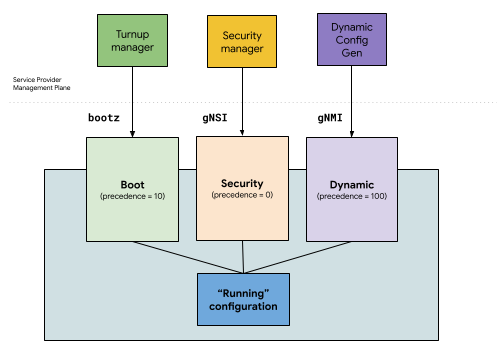
Figure 1: Proposed configuration namespaces and clients.
The proposed operational model for devices is shown in Figure 1 above.
- Security credentials (authorization, accounting, authentication) are considered part of security/auth namespace. gNSI manages this configuration store completely. It is considered a “precedence 0” store, whereby it is the authoritative source of configuration in the case of any overlap with other namespaces. Explicitly, this means that gNSI owns this configuration, and calls must be made to gNSI to mutate this store.
- Boot configuration (discussed in more detail in this document) is considered part of a bootstrap namespace. gNOI.Bootz manages this configuration store completely (proposed and described in this document). Boot configuration is considered a “precedence 10” store, with it being the authoritative source of configuration in the case of overlaps.
- Boot configuration is expressly defined to be immutable, and provided only
at the time of device boot. If the boot configuration is required to be
modified, it would be changed through calling a
SetRPC through theBootzservice.- When changing this configuration the device must "reapply" configuration
just as would be expected through a controller doing a
gnmi.Setunion-merge.
- When changing this configuration the device must "reapply" configuration
just as would be expected through a controller doing a
- Dynamic configuration reflects the current, widely-understood concept of
configuration on a network device. It is managed via gNMI. Each origin
within gNMI is assigned an explicit precedence. The precedence for origins
is defined in the relevant document - but the value suggested is >= 100,
i.e., for overlaps with other namespaces it is explicitly ignored. It is
expected that this is needed in the case that:
/system/aaais populated on the device running gNSI. In such a case, gNSI (in the auth namespace) is the source of truth.- Management interfaces, or running gRPC daemons are specified in the Boot
namespace, also in the
/systemor/interfaceshierarchies within the dynamic configuration.
CLI (via SSH or Console) as an API should have access to all the 3 namespaces above. It provides a low dependency method to recover the device in case of bugs/failures/emergencies.
To support this approach, this document proposes a Bootz service, which is the
mechanism by which the “boot” namespace is interacted with. Bootz is
proposed to replace the existing zero-touch-provisioning implementations.
Background
Currently, the industry standard[^2] is to use the base sZTP protocol for
bootstrapping devices. Current sZTP implementations require vendor specific
definitions for providing the bootstrapping of a device, because there is no
agreed upon vendor neutral data set of “boot configuration” defined. Bootz
provides a specification that enumerates the data elements which can be used in
a mainly vendor agnostic way, along with the operations that are required at
turn-up time that become part of the “boot” process. Specifically, we are
suggesting that TPM-related enrollment and attestation should be required during
the boot process to ensure the authenticity and integrity of the device
before providing it with potentially sensitive artifacts such as
certificates, keys and device configuration.
Reference Documentation
- External
- RFC: RFC8572
- Attestation: Charra Draft
Bootz Operation
Devices are expected to perform a standard DHCP boot. The DHCP server passes a boot option to the device for an endpoint (URL) from which the boot package can be retrieved. The package returned by the endpoint consists of a binary encoded protocol buffer containing all data for being able to complete the boot process. In this context, “complete the boot process” implies the device reaching a fully manageable state - with the relevant gRPC services running.
Upon receiving the bootz protocol buffer, the device is responsible for unmarshalling the bootz message and distributing to the relevant system components for these artifacts to be acted upon. For example, configuration to a configuration manager component, keys and credentials to the relevant security components, etc.
The bootz payload will be encrypted via the TLS session underlying the gRPC service.
Depending on the security requirement for the deployment environment, after loading all the provided data on first boot the device might still not be in a trusted state, however it should have enough g* services initialized to a state where the device can be interrogated from a trusted system to enroll the TPM and validate specific TPM values to attest the device. Once attested, the systems can install production configuration and certificates into the device.
Detailed Design
Boot Procedure: Unary Bootz
- DHCP Discovery of Bootstrap Server
- Device sends DHCP messages, containing the mac-address of the active control card. The DHCP server has been configured with all possible mac-addresses of the device, and responds with the static IP address of the bootstrap server.
- DHCP server also assigns an IP address and a gateway to the device.
- The DHCP response option code should be
OPTION_V4_SZTP_REDIRECT(143) orOPTION_V6_SZTP_REDIRECT(136). - The format of the DHCP message (other than response option code) follows
RFC.
- The URI will be in the format of
bootz://<hostname or ip>:<port>
- The URI will be in the format of
- Bootstrapping Service
- Device initiates a gRPC connection
Bootstrap.GetBootstrapDatato the bootz-server whose address was obtained from the DHCP server. - The TLS connection MUST be secured on the client-side with the IDevID of the active control card.
- The responses from the bootz-server are signed by ownership-certificate. The device validates the ownership-voucher, which authenticates the ownership-certificate. The device verifies the signature of the message body before accepting the message.
- If the signature could not be verified, the bootstrap process starts from Step 1.
- Device initiates a gRPC connection
Note: though a device SHOULD validate ownership by default, in some environment
(e.g. a lab) we might not want to do so. In this case, the device can be
explicitly configured to skip the ownership validation, and the device will then
not set the nonce field in the GetBootstrapDataRequest message. The
bootstrap server may proceed without signing the response and without providing
the ownership voucher and ownership certificate.
- Ownership Voucher and Ownership Certificate
- These artifacts have the same meaning as the original sZTP RFC. This document uses OC (Ownership Certificate) and PDC (Pinned Domain Cert) interchangeably for convenience. However, we should keep in mind that OV (Ownership Voucher) authenticates a PDC, and OC might be a distinct certificate with a chain of trust to the PDC.
- The contents of the
GetBootstrapDataResponsehas an inner message body. The outer message contains the Ownership Voucher, the Ownership Certificate and a signature over the inner message body. The signature is generated using the OC and the nonce.
- GetBootstrapDataRequest
- The bootz workflow is initiated by the device sending a
GetBootstrapDatagRPC to the bootz-server. - The device describes itself, by listing out all available control cards, and their states.
- For a full device install, the state of all control cards is
NOT_INITIALIZED. - For installing hot-swapped modules (RMA), the primary control card sets
its state to
INITIALIZED, and that of the swapped module toNOT_INITIALIZED.
- The bootz workflow is initiated by the device sending a
- GetBootstrapDataResponse
- The server responds with the intent for the device's baseline state. This includes the OS version and boot password hash, and an initial device configuration. This would include initial gNSI artifacts such as: certz,pathz,authz,credentialz artifacts to allow the device to progress to enrollment and attestation or even bring the device fully into a production state.
- The proto allows us to return multiple sets of configurations, one per control card. However, in practice, we usually apply the same configuration to both cards.
- For RMA, the server will return only one set of configuration - for the RMA'd module.
- The device/modules should download the OS image, verify its hash and
install the OS.
- A reboot may be performed, if required.
- The device/modules will then apply the configuration.
- A reboot may be performed, if required.
- The
GetBootstrapDatagRPC can be performed as many times as required (i.e. it is idempotent).
- ReportStatus
- This gRPC method is used by the device to inform the bootz server that the bootstrapping process is complete. Success or failure is indicated using an enum.
- In case of failure, the device should retry this process from Step 1.
- When making this gRPC, the device should verify the identity of the
server using the "
server_trust_cert" certificate obtained fromGetBootstrapDataResponse. - "
server_trust_cert" plays the same role as "trust-anchor" in the sZTP RFC (i.e. allows the device to verify the identity of the server). - The TLS connection MUST be secured on the client-side with the IDevID of the active control card.
- At this point, the device has a minimal set of configuration, enabling it to
receive gRPC calls. Depending on the operator's security policies, an
attestation-verification or an enrollment step may be performed.
- At Google, we plan to always require enrollment and attestation-verification.
- TpmEnrollment
- The enrollment API doc is the authoritative reference for this API. The API is reproduced here for convenience.
- This step allows the owner organization to install an owner IAK certificate on the device(s). This may be desirable if the owner requires periodic rotation of certificates and a revocation policy that is independent of the device vendor.
- The TpmEnrollment API is secured with the IDevID certificate.
- During enrollment, the server MUST verify that the serial number on the Attestation Key certificate matches the serial number on the IDevID certificate, and validate both certificates with the appropriate trust bundle.
- Attestation
- The attestation API doc is the authoritative reference for this API. The API is reproduced here for convenience.
- This step allows the owner to obtain cryptographic evidence for the integrity of the software components on the control-cards.
- The attestation API should be secured with IDevID for the first
attestation, and mTLS for subsequent attestations.
- On first attestation, the server MUST verify that the serial number on the Attestation Key certificate matches the serial number on the IDevID certificate, and validate both certificates with the appropriate trust bundle.
- On modular devices, the active control card obtains attestation evidence
from the standby, and relays it to the bootz server. The active control
card must verify the identity of the standby during this process. The
standby control card's ability to communicate with the active card is
not sufficient evidence of identity.
- This specification does not prescribe how to verify the identity of the standby, as the communication between the control cards takes place over vendor-proprietary protocols. However, at a minimum, the active control card must check that the standby's TPM-backed IDevID. For example, it may request the IDevID cert, then issue a decrypt challenge to the standby control card.
- Final state:
- At this point, the device has an initial configuration and user accounts. We have validated the identity and integrity of the device and its software components. It is ready to serve traffic.
Bootz Procedure: BootstrapStream v0.6
NOTE: BootstrapStream v0.6 is deprecated, please use BootstrapStream v1.0 below instead.
BootstrapStream v0.6 only supports TPM 2.0 (with or without IDevID) systems, while TPM 1.2 systems are not supported.
- DHCP Discovery of Bootstrap Server
- Device sends DHCP messages, containing the mac-address of the active control card. The DHCP server has been configured with all possible mac-addresses of the device, and responds with the static IP address of the bootstrap server.
- DHCP server also assigns an IP address and a gateway to the device.
- The DHCP response option code should be
OPTION_V4_SZTP_REDIRECT(143) orOPTION_V6_SZTP_REDIRECT(136). - The format of the DHCP message (other than response option code) follows
RFC.
- The URI will be in the format of
bootz://<hostname or ip>:<port>
- The URI will be in the format of
- Bootstrapping Service
- Device initiates a gRPC connection
Bootstrap.BootstrapStreamto the bootz-server whose address was obtained from the DHCP server. - The device MUST NOT present a client certificate in the TLS handshake.
- Device initiates a gRPC connection
- BootstrapStreamRequest.bootstrap_request
- The bootz BootstrapStream is initiated by the device sending a
GetBootstrapDataRequestmessage to the bootz-server in the first message of the stream. - The device describes itself, by listing out all available control cards, and their states.
- For a full device install, the state of all control cards is
NOT_INITIALIZED. - For installing hot-swapped modules (RMA), the primary control card sets
its state to
INITIALIZED, and that of the swapped module toNOT_INITIALIZED. - The device should set the
bootstrap_request.identityfield as below:- For TPM 2.0 with IDevID, populate
idevid_certwith the IDevID certificate. - For TPM 2.0 without IDevID, set
ek_ppk_pubto true.
- For TPM 2.0 with IDevID, populate
- The bootz BootstrapStream is initiated by the device sending a
- BootstrapStreamResponse.challenge
- The server will provide a challenge depending on the data fetched from
OVGS (Ownership Voucher gRPC Service) server based on the
GetBootstrapDataRequest.identity.- For TPM 2.0 with IDevID:
- The IDevID cert will be validated and the S/N will be used to validate the device.
- A nonce challenge will be sent to the device.
- For TPM 2.0 without IDevID:
- The
GetBootstrapDataRequest.chassis_descriptordata will be used to get the S/N. - The S/N will be validated by lookup in OVGS and then use the key returned (EK/PPK) to encrypt an importable HMAC challenge.
- The
- For TPM 2.0 with IDevID:
- The server will provide a challenge depending on the data fetched from
OVGS (Ownership Voucher gRPC Service) server based on the
- BootstrapStreamRequest.response
- The device should populate the
Responsemessage as below:- For TPM 2.0 with IDevID, the
Responsemessage contains the nonce signed via IDevID, which can validate that the device is in fact the device expected. - For TPM 2.0 without IDevID, the
Responsemessage contains the HMAC challenge response, which can validate that the device is in possession of the EK/PPK.
- For TPM 2.0 with IDevID, the
- The device should populate the
- BootstrapStreamResponse.bootstrap_response
- Bootz-server verifies the challenge response received from the device:
- If the challenge response is valid the server will send the bootstrap data.
- If the challenge fails an error will be returned and the device must start over from Step 1.
- The server responds with the intent for the device's baseline state. This includes the OS version and boot password hash, and an initial device configuration. This would include initial gNSI artifacts such as: certz,pathz,authz,credentialz artifacts to allow the device to progress to enrollment and attestation or even bring the device fully into a production state.
- The
BootstrapDataResponsemessage from the bootz-server is signed by ownership-certificate. The device validates the ownership-voucher, which authenticates the ownership-certificate. The device verifies the signature of the message body before accepting the message. - If the signature could not be verified, the bootstrap process starts from Step 1.
- The proto allows us to return multiple sets of configurations, one per control card. However, in practice, we usually apply the same configuration to both cards.
- For RMA, the server will return only one set of configuration - for the RMA'd module.
- The device/modules should download the OS image, verify its hash and
install the OS.
- A reboot may be performed, if required.
- The device/modules will then apply the configuration.
- A reboot may be performed, if required.
- Bootz-server verifies the challenge response received from the device:
- BootstrapStreamRequest.report_status_request
- The device sends a
ReportStatusRequestmessage to the bootz-server.- If bootstrapping is successful, the device should report all control
cards as
CONTROL_CARD_STATUS_INITIALIZEDandBOOTSTRAP_STATUS_SUCCESS. - If bootstrapping is not successful, the device may report status as
BOOTSTRAP_STATUS_FAILUREand then should restart the process from Step 1.
- If bootstrapping is successful, the device should report all control
cards as
- The device sends a
- BootstrapStreamResponse.report_status_response
- If the device did not terminate the current stream (i.e., no reboot
ever happened during this entire process), the bootz-server will
respond with an empty
ReportStatusResponsemessage to acknowledge the status report. - If the device terminated the previous stream (e.g., due to a reboot),
so that the
ReportStatusRequestmessage received by the bootz-server is the first message in a new stream, then bootz-server will send out a new challenge again (refer to Step 4 through 7) to verify the identity of the device. Once the challenge passes, bootz-server will finally send out an emptyReportStatusResponsemessage to acknowledge the status report. If the challenge fails, an error will be returned and the device must start over from Step 9.
- If the device did not terminate the current stream (i.e., no reboot
ever happened during this entire process), the bootz-server will
respond with an empty
Bootz Procedure: BootstrapStream v1.0
- DHCP Discovery of Bootstrap Server
- Device sends DHCP messages, containing the mac-address of the active control card. The DHCP server has been configured with all possible mac-addresses of the device, and responds with the static IP address of the bootstrap server.
- DHCP server also assigns an IP address and a gateway to the device.
- The DHCP response option code should be
OPTION_V4_SZTP_REDIRECT(143) orOPTION_V6_SZTP_REDIRECT(136). - The format of the DHCP message (other than response option code) follows
RFC.
- The URI will be in the format of
bootz://<hostname or ip>:<port>
- The URI will be in the format of
- Bootstrapping Service
- Device initiates a gRPC connection
Bootstrap.BootstrapStreamV1to the bootz-server whose address was obtained from the DHCP server. - The device MUST NOT present a client certificate in the TLS handshake.
- Device initiates a gRPC connection
- BootstrapStreamRequestV1.bootstrap_request
- The BootstrapStreamV1 RPC is initiated by the device sending a
GetBootstrapDataRequestmessage to the bootz-server in the first message of the stream. - The device describes itself, by listing out all available control cards, and their states.
- For a full device install, the state of all control cards is
NOT_INITIALIZED. - For installing hot-swapped modules (RMA), the primary control card sets
its state to
INITIALIZED, and that of the swapped module toNOT_INITIALIZED. - The device should set the
bootstrap_request.identityfield as below:- For TPM 2.0 with IDevID, populate
idevid_certwith the IDevID certificate. - For TPM 2.0 without IDevID, the device can choose to use EK or PPK.
If using EK, populate
tpm20_ek_pubwith EK public key; if using PPK, populatetpm20_ppk_pubwith PPK public key. - For TPM 1.2, populate
tpm12_ek_pubwith EK public key.
- For TPM 2.0 with IDevID, populate
- (Applicable to TPM 1.2 devices only) The device should invoke
TPM_MakeIdentitycommand to create a placeholder AIK, then calculate the SHA1 digest over the TPM_PUBKEY structure of the created AIK public key, and populate the SHA1 digest into theaik_pub_digestfield.
- The BootstrapStreamV1 RPC is initiated by the device sending a
- BootstrapStreamResponseV1.challenge_request
- Bootz server will send a challenge request depending on the data fetched
from OVGS (Ownership Voucher gRPC Service) server based on the received
GetBootstrapDataRequest.identity.- For TPM 2.0 with IDevID:
- The IDevID cert will be validated and the S/N will be used to validate the device.
- A
tpm20_idevidchallenge request which contains a nonce will be sent to the device.
- For TPM 2.0 without IDevID:
- The
GetBootstrapDataRequest.chassis_descriptordata will be used to get the S/N. - The S/N will be validated by a lookup in OVGS, and then the returned
EK/PPK public key will be used to encrypt an importable
tpm20_hmacchallenge request which contains an HMAC-SHA256 key.
- The
- For TPM 1.2:
- The
GetBootstrapDataRequest.chassis_descriptordata will be used to get the S/N. - The S/N will be validated by a lookup in OVGS, and then the returned
EK public key will be used together with the received
GetBootstrapDataRequest.aik_pub_digestto encrypt atpm12_ekchallenge request which contains an HMAC-SHA256 key.
- The
- For TPM 2.0 with IDevID:
- Bootz server will send a challenge request depending on the data fetched
from OVGS (Ownership Voucher gRPC Service) server based on the received
- BootstrapStreamRequestV1.challenge_response
- The device should populate the
ChallengeResponsemessage as below:- For TPM 2.0 with IDevID, populate the
tpm20_idevidfield of this message. First create aTransportKeymessage by generating an ephemeral HPKE key according to the chosen cipher suite, then copy the receivednonceinto it, and serialize theTransportKeymessage into the wire format, finally generate asignatureby signing theserialized_transport_keyfield using the IDevID private key. - For TPM 2.0 without IDevID, populate the
tpm20_hmacfield of this message. First create aTransportKeymessage by generating an ephemeral HPKE key according to the chosen cipher suite, and serialize theTransportKeymessage into the wire format, then invokeTPM2_Importcommand to import the received HMAC-SHA256 key into TPM, finally invokeTPM2_Certifycommand to certify any TPM residing key using the imported HMAC-SHA256 key. When invokingTPM2_Certifycommand, thequalifyingDataargument must be set to the SHA256 hash over theserialized_transport_keyfield. - For TPM 1.2, populate the
tpm12_ekfield of this message. First create aTransportKeymessage by generating an ephemeral HPKE key according to the chosen cipher suite, and serialize theTransportKeymessage into the wire format, then invokeTPM_ActivateIdentitycommand with the receiviedblob_encryptedand the earlier created placeholder AIK as arguments to decrypt the HMAC-SHA256 key, and calculate thehashover theserialized_transport_keyfield using the HMAC-SHA256 key, finally discard the earlier created placeholder AIK.
- For TPM 2.0 with IDevID, populate the
- The device should populate the
- BootstrapStreamResponseV1.bootstrap_response
- Bootz server verifies the challenge response received from the device:
- If the challenge response is valid the server will send the bootstrap data.
- If the challenge fails an error will be returned and the device must start over from Step 1.
- Bootz server creates
BootstrapDataResponsemessages with the intent for each of the device's control cards. This includes the OS image, boot password hash, an initial device configuration and initial gNSI artifacts such as: certz, pathz, authz, credentialz to allow the device to progress to enrollment and attestation or even bring the device fully into a production state. - Bootz server then creates a
BootstrapDataSignedmessage, serializes this message into the wire format, and encrypts the serialized message using the received HPKE public key. - The resulting
encrypted_serialized_bootstrap_datafield is finally signed by the ownership-certificate, before sending to the device. - When the device receives the
bootstrap_response, it should first validate theownership_voucher, then useownership_voucherto verify theownership_certificate. The device should also verify theresponse_signatureagainst theencrypted_serialized_bootstrap_datausing theownership_certificate, before accepting the message. If any validation above fails, the device should restart the bootstrap process from Step 1. - The device decrypts the
encrypted_serialized_bootstrap_datausing the receivedencapsulated_keyalong with the HPKE private key, and then deserializes it to get aBootstrapDataSignedmessage. The device should verify thenoncefield in this message. If the validation fails, the device should restart the bootstrap process from Step 1. - The decrypted and deserialized
BootstrapDataSignedmessage allows us to return multiple sets ofBootstrapDataResponse, one per control card. In practice, we usually apply the same configuration to both cards. For RMA, Bootz server will return only one set of configuration--for the RMA'd module (i.e. control card). - The device/modules should download the OS image, verify its hash and
install the OS.
- A reboot may be performed, if required.
- The device/modules should then apply the configuration.
- A reboot may be performed, if required.
- Bootz server verifies the challenge response received from the device:
- BootstrapStreamRequestV1.report_status_request
- The device sends a
ReportStatusRequestmessage to Bootz server.- If bootstrapping is successful, the device should report all control
cards as
CONTROL_CARD_STATUS_INITIALIZEDandBOOTSTRAP_STATUS_SUCCESS. - If bootstrapping is not successful, the device may report status as
BOOTSTRAP_STATUS_FAILUREand then should restart the process from Step 1.
- If bootstrapping is successful, the device should report all control
cards as
- (Applicable to TPM 1.2 devices only) If this
ReportStatusRequestmessage is the first message in a new stream (i.e., there was a reboot breaking the previous stream), then the device should also populate theaik_pub_digestfield. If thisReportStatusRequestmessage is not the first message in current stream (i.e., no stream-breaking reboot happened before), then thisaik_pub_digestfield does not need to be populated. - The device may repeat sending
ReportStatusRequestmessage periodically in order to update the bootstrapping status in real time, until the bootstrapping process finishes or fails.
- The device sends a
- BootstrapStreamResponseV1.report_status_response
- If the device did not terminate the current stream (i.e., no reboot
ever happened during this bootstrapping process), Bootz server will
respond with an empty
ReportStatusResponsemessage to acknowledge the status report. - If the device terminated the previous stream (e.g., due to a reboot),
so that the
ReportStatusRequestmessage received by Bootz server is the first message in a new stream, then Bootz server will send out a newChallengeRequestagain (refer to Step 4 through Step 5) to verify the identity of the device again. Once the challenge passes, Bootz server will finally send out an emptyReportStatusResponsemessage to acknowledge the status report. If the challenge fails, an error will be returned and the device must start over from Step 7.
- If the device did not terminate the current stream (i.e., no reboot
ever happened during this bootstrapping process), Bootz server will
respond with an empty
A Note on Modular Devices
Many commercial modular form-factor devices start copying data from the active control card to a hot-swapped standby immediately on plugging in. This includes sensitive data such as credentials and certificates. From a security standpoint, this is undesirable.
We recommend that the active card copy system software only (includes firmware, bootloader, boot password and OS image), then restart the hot-swapped card. It should verify the standby card's identity (using IDevID verified against the vendor root of trust) and attestation evidence (which should match the active card's PCR values) before copying the operator-provided operational configuration.
Alternatively, the active card can perform the bootstrapping, enrollment and attestation workflow on behalf of the standby before copying operational configuration.
Workflows for RMA replacement
- Card failure detected
- Card RMA issued
- Card replaced
- Active control card detects new standby control card
- Active control card tries to verify new standby card via IDevID
- Active control card verifies standby card software and firmware is at least at it's own version. a. If not, it will send over the firmware and software and perform an upgrade.
- The chassis will update gNMI with component in inserted but not enrolled state.
- Kick off workflow for initialization of new control card a. Inventory system detects unenrolled control card and kicks off workflow to the enrollment/attestion system. b. Active control card sends bootz request to bootserver containing serial number of new card, and gets back bootz artifacts.
- Inventory service makes call to enrollment API and provides proper OV for the new control card.
- Inventory service makes call to attestation API to verify attestation values.
- Active control card now verifies the new card, brings the new card into production state and sync's configuration and other files.
Certificate deployment options
Bootz only
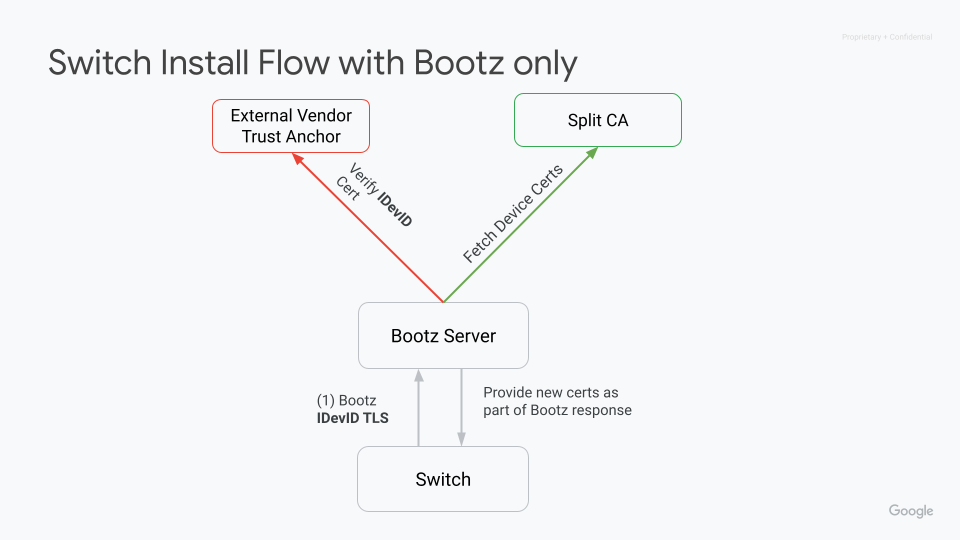
In the Bootz only workflow certificates are delivered by the bootz server in the initial bootz data payload. After reboot the device will use the provided security profile and certificates provided in the bootz message.
Bootz with Certz rotation
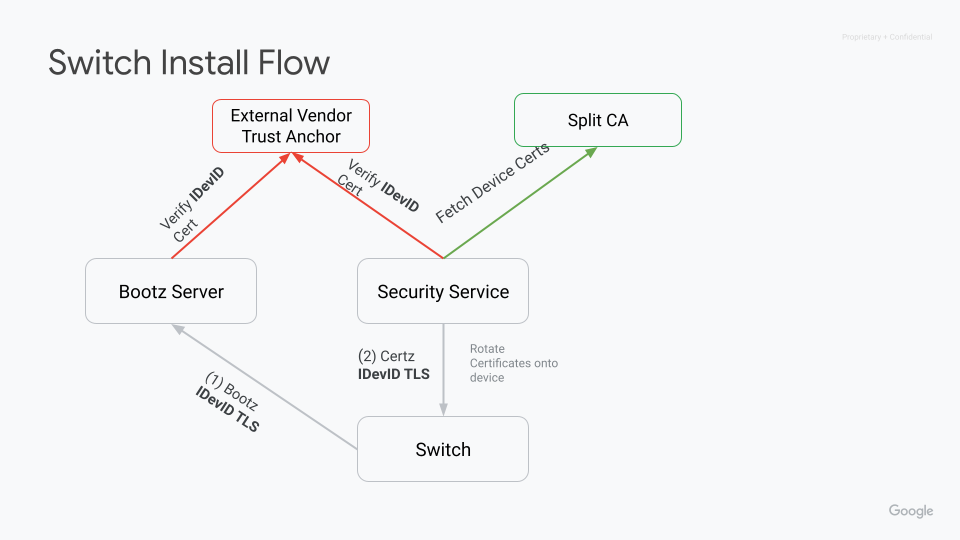
In this workflow the device will boot from bootz but will use it's IDevID cert for initial services. Once rebooted, the device can be reached via Certz using the IDevID cert.
Bootz with Enrollz and Attestz
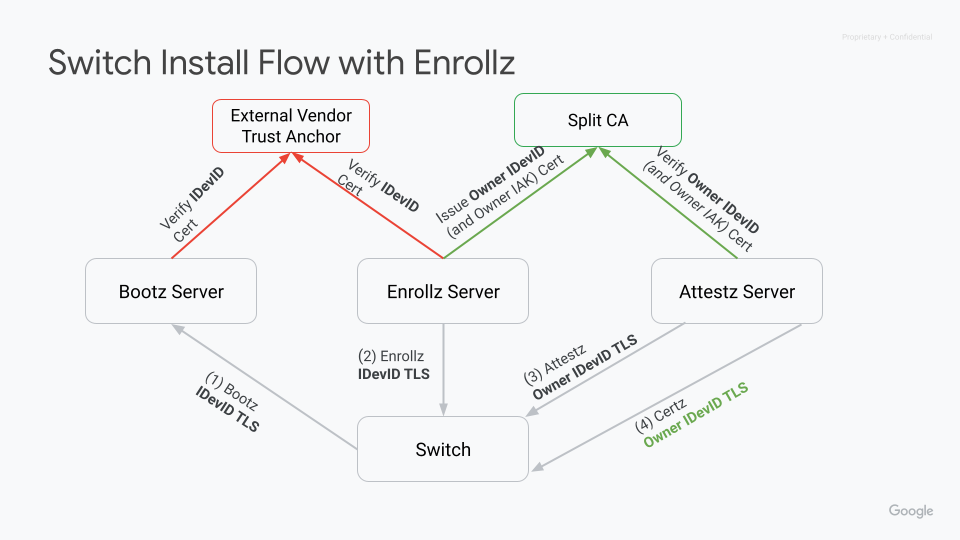
This is the preferred workflow for security considerations. This workflow utilizes Enrollz and Attestz to provide enrollment then measured boot to validate the state of device before providing any "production" certificates.
Protobuf Payload for Bootstrap
The following protocol buffer is provided from the bootz-server to the device to provide the bundle of artifacts needed for the device to reach a manageable state.
See PR